CQC State of health care and adult social care in England 2024/25 published
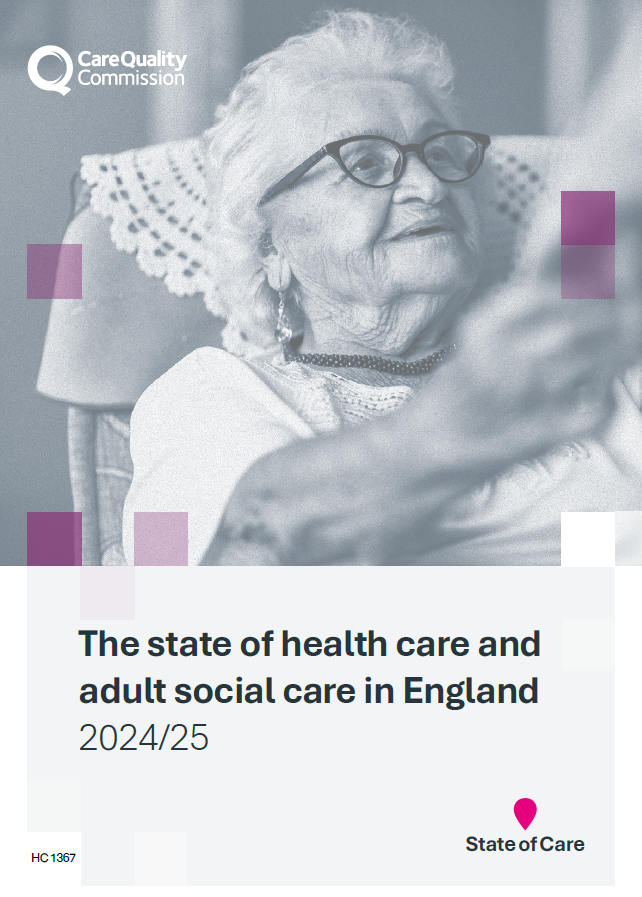
Front cover of CQC Sate of health care and adult social care in England report 2024/25
The CQC published its annual report on 23rd October 2025. Here are some of its key findings.
1. Overarching picture
· The system remains highly pressured and fragmented. The CQC says the health and social care system is “fragmented and under severe strain” as it tries to shift more care into the community and neighbourhood settings.
· That ambition – of moving care away from hospital-based settings and into more local, community-based models – is not yet matched by capacity, workforce, investment or joined-up pathways.
2. Demand, access and service capacity
· Demand across almost all parts of the system is rising. For example, referrals to secondary mental health services have increased.
· There are continuing issues with access: difficulties getting appointments, delays in community services, and knock-on pressure on urgent and emergency care.
· Beds, workforce and home-care capacity remain tight. Although numbers of beds may have increased, so has population demand, so margins for safety are narrow.
3. Workforce and staffing pressures
· Staffing shortages remain acute in both health and social care. In adult social care, vacancy levels are reported to be three times higher than the wider job market.
· International recruitment has dropped, largely because of visa changes, and this adds to concerns about replenishing the workforce.
· The CQC warns that unless workforce strategy, pay and support improve, services may struggle to deliver safe and responsive care — particularly in community and social care settings.
4. Adult social care — key themes
· There is a tension between ambition and capability: more people are being supported to live more independently (for example in supported living) but quality and oversight aren’t keeping pace with growth.
· Financial and market sustainability risks: the report highlights that homecare providers (especially small ones) may lack the resilience required — raising concerns about continuity of service, quality, and workforce turnover.
5. Mental health, learning disability, autism
· Demand for mental health services is climbing: new referrals to secondary services are up substantially.
· People’s experience of care, coordination between services and transitions remain problematic — particularly for crisis and inpatient services. The CQC notes descriptions from providers of the pressure as “overwhelming” and “scary”.
6. Implications for providers, training and practice
· Prioritise workforce sustainability: recruitment, retention, reducing turnover, making roles attractive, improving pay/conditions, and supporting development.
· Sustain quality amid growth: For services expanding rapidly (e.g., supported living) ensure governance, oversight, consistency of standards, and resilience of small-scale providers.
· Embed innovation carefully but safely: While new models (digital, outreach, flexible delivery) matter, they must be matched with staff capability, supervision and regulatory compliance.
· Use the report for training content: The findings offer rich material for scenario-based reflection.
Final thoughts
The 2024/25 State of Care report puts into sharper relief the scale of the challenge ahead: rising demand, tighter funding, workforce fragility, complex pathways, fragmented systems, and persistent inequalities.
For those in social care and training roles this means re-thinking how we prepare staff, design services and deliver care — not just in terms of “doing the job” but how we remake the system, embed values, deliver inclusion and build sustainable, high-quality support. The regulator’s message is clear: the ambition is real, but unless the underpinning infrastructure improves, there is a real risk that quality will erode rather than improve.